Ultimate Journey

Well this is unintentionally timely! After reading Bloody Hell! Adventures in Menopause from Around the World, I’ve had further thoughts about gender and identity and I just happened to decide to write about them during the week of the 47th President of the United State’s inauguration. Normally these two things would be completely unrelated, it’s not like a cis-man would naturally connect to a book about lived experiences of menopause, but one of the Executive Orders signed after the inauguration stated that the federal government would only recognize two genders going forward. The order also laid out “biological” definitions of those two genders that are questionable, but I’m not really interested in talking about that here – there are many people who are better suited to that conversation. Suffice it to say that I disagree with the current American president’s order from on high and am terrified for how his proclamation is being received here in Canada.

What’s in a womb, I wondered? What does it really mean? — Una Mullally, p. 166

Last time I talked about this book, I discussed my struggles with loss of my access to my brain. This time, I’m interested in connecting to the changes to gender that the stories in the book allowed me to consider. I’ve never before considered that I was anything but a woman — never questioned my gender once — but this stage of life has me wondering what that definition means more and more. I’ve never planned to birth children, but I still had all the requisite parts. I vividly remember telling a group of girl friends that the only good thing I could see about pregnancy itself was the loss of your period for nine months (turns out not even that is true!). We were probably 13 years old at the time and the look of shock on all faces ensured that I never mentioned that position in public again (I wasn’t against children, I just didn’t feel child birth was a necessary part of the process). Of that group of five girls, by the way, three of them had eight children between them and two of us remain childless by choice. Even when faced with the possibility of losing some of those parts to protect the rest of my body from possible cancer growth, I never questioned my position as a woman. I may not always act like a “girlie-girl,” but I identify as woman.

So, I don’t think that my “woman-ness” or femininity has ever been tied to my reproductivity. Why is it that now, when that reproductivity is absolutely leaving me, am I questioning what makes a woman (for me)? Certainly some of that questioning must be tied to society’s expectations of women and the discourse surrounding menopause — I’m not sure anyone can completely ignore the conversations that tie a woman’s worth to her ability to reproduce. However, I’ve been eagerly anticipating my new role as “crone” or “spinster.” Just as I’m achieving my long-awaited goal, I seem to be taking a step back and wondering if those terms are too gendered even for where I am in my journey.

for cis women, mainstream depictions of menopause include a sort of neutering or de-womanising — M’Kali-Hashiki, p. 206

To be clear, I am not suggesting that I am on a trans journey of discovery and that I will emerge from this as the reborn non-binary (or trans-masc) unique being that I was always meant to be. No, this is not that kind of questioning. This is the kind that wonders how I embody my gender as I age in a society that increasingly ignores me and has no use for me. This comes with a sense of freedom — my clothes, hairstyle, and footwear are all much more comfortable now than they were 20 years ago — but also a (re)learning. I have memories and experiences that I know represent me, but that I also know don’t represent the me that I am anymore.

We need a word … for the grief of losing our past selves. We need a ritual that can serve as a baton connecting the ellipses between what we were and what we are becoming — Mona Eltahawy, p. 233

So while I’m learning how to live in this new time and how to feel comfortable in this new skin that feels a bit like another gender, I’m also thinking about how this is the next part of the journey for everyone. In Bloody Hell!, Ann Marie McQueen likens menopause to a stage in “the ultimate Hero’s Journey” (p. 131) and I love this idea. The idea that menopause is one of the later stages of the Hero’s Journey where we get to gather and regale one another with tales of past glories is very appealing.

In any case, I feel, as I did when beginning puberty, as a blob of modelling clay ready to be shaped into something new and both scared and excited to discover who I can be when I come out on the other side. I suspect I’ll care less about fitting in than I did during/post-puberty and I’m hoping for more self-confidence, but it’s more likely I’ll just be less concerned with what people think and I guess that’s ok too.

verily, Transformation is excruciating. — Mohja Kahf, p. 88

If you like the quotations I included and think this collection of essays might be for you or someone you care about, the book is amazing! It was published by Unbound, a publisher that uses a built-in crowdfunding publication model. The book comes out in March of 2025 and I wrote an actual book review on StoryGraph if you’d like to read that.
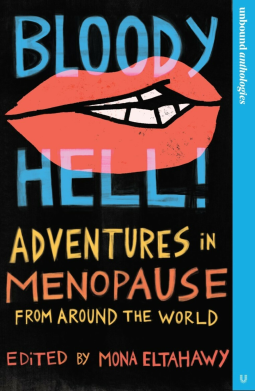
Eltahawy, Mona, ed. Bloody Hell! Adventures in Menopause from Around the World. Unbound. Digital ISBN/UID: 9781800183711, 6 March 2025.
The Great Transition

It seems only right that the thing that should get me actively writing again is a book of essays about menopause — the ultimate transition for adults with a uterus. The collection, Bloody Hell! Adventures in Menopause from Around the World, is edited by Mona Eltahawy and brings together essays by 17 individuals about their own experiences with menopause. It is inspiring and surprisingly helpful for a non-medical, non-self-help collection of writing. Given the dearth of actual, useful information available on the menopause journey, though, I suppose it shouldn’t be that surprising that a book of people talking about their own experiences would include useful nuggets of knowledge!

I don’t remember what I used to be and I don’t know who I am becoming. But I welcome her! — Mona Altahawy p. xiv

While reading these essays, I felt like each new writer was perfectly capturing my story even though I am a cis white woman in Canada and the authors are Black, Brown, Asian, trans, nonbinary, cis, people living all over the world. The menopause journey may be as individual as the people experiencing it, as Eltahawy says in the introduction (p. xvii), but the fear, frustration, lack of knowledge, and acceptance certainly feel universal when laid out like this.

My entire life is built around my brain. Letting it fog up could be devastating to my career as a professor, a researcher, a writer” — Sonora Jha p. 68

Many of the authors in the book talk of the freedom of menopause and of finding ways to embrace this transition, even as they had to learn to come to grips with it. This is the part that struck a chord with me the most and resonates the most for my writing and future. It’s the first part that is the hardest though — coming to grips with the transition and getting through it.

While I am still perimenopausal, I was diagnosed with idiopathic intracranial hypertension in 2017 after some time in hospital. At the time, I had the exact same crisis of “faith” as Jha mentions in the quotation above — who am I without my brain? I couldn’t (and still can’t) pull facts out of the aether like a magician, discuss topics endlessly and widely like a wizened philosopher (or pothead, depending on your love for philosophy), or even remember the words for everyday items. I had to relearn how to read comfortably and I regularly made up words that I was sure were real or used completely inaccurate words in place of the real ones. It was terrifying. I wrote everything down when I had to present anything and cut back on the number of public events I did. I also slept a lot more, drank more water, and adjusted the food I ate along with adding new meds to my diet.

I improved with time, medication, and dealing with other medical issues that came up during/after this diagnosis. I got used to the new normal. I can’t multitask as well as I used to, I can’t hold as many ideas in my head at once, and I only occasionally forget words for things I use everyday now. Until things changed again. I went to the doctor scared that things were getting worse. I had an eye test to see if the pressure in my head was worse. I did a cognitive test that is usually only completed by seniors to test for Alzheimer’s. I passed, though I felt I was slower than I could have been. Neurologists say there’s nothing wrong. My eye doctor says there’s no negative change.

My nurse practitioner and I have begun discussing perimenopause during our well woman appointments. I can’t have estrogen supplements because I have a clotting disorder so she looks for non-hormonal options for me, but neither one of us knows what this means for me when HRT becomes necessary so we’re trying to get me into an ob/gyn before then. None of that helps when my brain fails me and I wonder who I am now.

I want to be present in this time in my life, not thinking wistfully about my ‘fertile’ years and not rushing ahead to senior citizen” — M’Kali-Hashiki p. 200

In January 2023, I made the decision to begin working full time at my corporate job rather than work full time hours for them, while also trying to do multiple jobs. I jumped into corporate culture and onto the corporate ladder with both feet. I think I did a pretty good job — I got a couple of promotions, title changes, and raises, including moving to a different department entirely and into the most challenging role I’ve had in my life to this point. It was exciting and I felt supported. I thought it would be easier, in some ways, than what I had been doing: I had one job, my focus wasn’t split in many directions, when my workday was over, I was done for the day, and the work didn’t tax my brain in the same way. This isn’t to say it wasn’t challenging or difficult — I wouldn’t have wanted to do it if it wasn’t challenging in some way — but I wasn’t developing new ideas, researching them, and writing about them in isolation on a regular basis. I did that from time to time, but the projects were much smaller, and the research was much more superficial. I felt confident I could do this job even on my “bad brain” days. And I was doing it well. And then I was let go in November of 2024. Not quite 2 years from deciding to go all in with this direction.

Now I wonder, had it been enough? Can I just never access the parts of my brain that I used to touch so easily as I descend further into the brain fog that began with my diagnosis and continues with perimenopause? Or do I just need to rethink how I work, the speed at which I work, and how and what I choose to write about?

The self is not a static point in time, but rather an evolution of selves — Mona Eltahawy p. 235

Eltahawy’s collection took me in so many directions that there will be other posts about this, but I wanted to start with the one that kept floating to the top of my (overly-pressured) brain — coming to grips with the loss of self, when your self is so tied to your intelligence. And I want to be clear that this is tough for everyone — losing the ability to know why you are doing anything is terrifying and a huge loss of self, but I can only speak for myself here and losing my brain felt, and some days continues to feel, like becoming a completely different person. When I go out into the world on a bad brain day and try to be the person people expect me to be, I’m worse than if I didn’t try. So, if you see me and I’m not who you think I always was, maybe I’ve finally decided it’s not worth the effort to try to be the old me anymore.

If you like the quotations I included and think this collection of essays might be for you or someone you care about, the book is amazing! It was published by Unbound, a publisher that uses a built-in crowdfunding publication model which is super innovative and I’ll probably write about this too! The book comes out in the UK in March of 2025 and should be available in North America by June of 2025 (but check in March!). I wrote an actual book review on StoryGraph if you’d like to read that.

Eltahawy, Mona, ed. Bloody Hell! Adventures in Menopause from Around the World. Unbound. Digital ISBN/UID: 9781800183711, 6 March 2025.