Well this is unintentionally timely! After reading Bloody Hell! Adventures in Menopause from Around the World, I’ve had further thoughts about gender and identity and I just happened to decide to write about them during the week of the 47th President of the United State’s inauguration. Normally these two things would be completely unrelated, it’s not like a cis-man would naturally connect to a book about lived experiences of menopause, but one of the Executive Orders signed after the inauguration stated that the federal government would only recognize two genders going forward. The order also laid out “biological” definitions of those two genders that are questionable, but I’m not really interested in talking about that here – there are many people who are better suited to that conversation. Suffice it to say that I disagree with the current American president’s order from on high and am terrified for how his proclamation is being received here in Canada.
What’s in a womb, I wondered? What does it really mean? — Una Mullally, p. 166
Last time I talked about this book, I discussed my struggles with loss of my access to my brain. This time, I’m interested in connecting to the changes to gender that the stories in the book allowed me to consider. I’ve never before considered that I was anything but a woman — never questioned my gender once — but this stage of life has me wondering what that definition means more and more. I’ve never planned to birth children, but I still had all the requisite parts. I vividly remember telling a group of girl friends that the only good thing I could see about pregnancy itself was the loss of your period for nine months (turns out not even that is true!). We were probably 13 years old at the time and the look of shock on all faces ensured that I never mentioned that position in public again (I wasn’t against children, I just didn’t feel child birth was a necessary part of the process). Of that group of five girls, by the way, three of them had eight children between them and two of us remain childless by choice. Even when faced with the possibility of losing some of those parts to protect the rest of my body from possible cancer growth, I never questioned my position as a woman. I may not always act like a “girlie-girl,” but I identify as woman.
So, I don’t think that my “woman-ness” or femininity has ever been tied to my reproductivity. Why is it that now, when that reproductivity is absolutely leaving me, am I questioning what makes a woman (for me)? Certainly some of that questioning must be tied to society’s expectations of women and the discourse surrounding menopause — I’m not sure anyone can completely ignore the conversations that tie a woman’s worth to her ability to reproduce. However, I’ve been eagerly anticipating my new role as “crone” or “spinster.” Just as I’m achieving my long-awaited goal, I seem to be taking a step back and wondering if those terms are too gendered even for where I am in my journey.
for cis women, mainstream depictions of menopause include a sort of neutering or de-womanising — M’Kali-Hashiki, p. 206
To be clear, I am not suggesting that I am on a trans journey of discovery and that I will emerge from this as the reborn non-binary (or trans-masc) unique being that I was always meant to be. No, this is not that kind of questioning. This is the kind that wonders how I embody my gender as I age in a society that increasingly ignores me and has no use for me. This comes with a sense of freedom — my clothes, hairstyle, and footwear are all much more comfortable now than they were 20 years ago — but also a (re)learning. I have memories and experiences that I know represent me, but that I also know don’t represent the me that I am anymore.
We need a word … for the grief of losing our past selves. We need a ritual that can serve as a baton connecting the ellipses between what we were and what we are becoming — Mona Eltahawy, p. 233
So while I’m learning how to live in this new time and how to feel comfortable in this new skin that feels a bit like another gender, I’m also thinking about how this is the next part of the journey for everyone. In Bloody Hell!, Ann Marie McQueen likens menopause to a stage in “the ultimate Hero’s Journey” (p. 131) and I love this idea. The idea that menopause is one of the later stages of the Hero’s Journey where we get to gather and regale one another with tales of past glories is very appealing.
In any case, I feel, as I did when beginning puberty, as a blob of modelling clay ready to be shaped into something new and both scared and excited to discover who I can be when I come out on the other side. I suspect I’ll care less about fitting in than I did during/post-puberty and I’m hoping for more self-confidence, but it’s more likely I’ll just be less concerned with what people think and I guess that’s ok too.
verily, Transformation is excruciating. — Mohja Kahf, p. 88
If you like the quotations I included and think this collection of essays might be for you or someone you care about, the book is amazing! It was published by Unbound, a publisher that uses a built-in crowdfunding publication model. The book comes out in March of 2025 and I wrote an actual book review on StoryGraph if you’d like to read that.
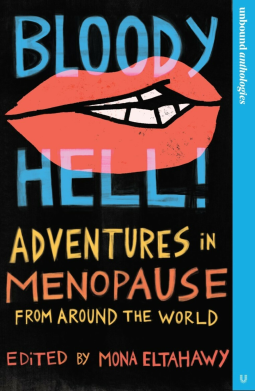
Eltahawy, Mona, ed. Bloody Hell! Adventures in Menopause from Around the World. Unbound. Digital ISBN/UID: 9781800183711, 6 March 2025.
 Jessica Bay